Define the research
Introduce the topic, research question, objective, and problem your study addresses.


Move beyond the blank page. WriteWise helps researchers turn their research topic, objectives, methodology, and available findings into a guided academic first draft.
Instead of relying on a generic writing prompt, begin with questions designed around scientific manuscript development—then review, revise, and shape the draft yourself.
5-day trial · Payment method required · Cancel before the trial ends to avoid a charge. View pricing and billing terms.
 AI Paper Drafter
FROM STUDY DETAILS TO AN EDITABLE STARTING DRAFT
AI Paper Drafter is designed for researchers who already have a research direction and need help expressing it in a more systematic way. It does not replace the underlying study.
Introduce the topic, research question, objective, and problem your study addresses.
Describe your study design, procedures, data, and other details already established by your research.
Use guided AI assistance to organize ideas into an initial manuscript structure and academic prose.
Revise the argument, verify every claim and source, and improve the text before submission.
Explore an illustrative scientific-writing workflow. Select each stage to see how research details can be organized into a manuscript framework.
The quality of a draft depends on the accuracy and completeness of the study details you supply.
The fields on the right are representative examples of the type of information a researcher can organize before drafting.
A starting framework helps reveal which parts of the paper are ready and where scientific information is still missing.
This is sample prose written only to demonstrate the distinction between an objective and a claim of results. It is not copied from the platform.
Urban vegetation may play an important role in local temperature variation. Understanding how green-space distribution relates to observed conditions can help frame research questions about urban environments. This study examines the association between vegetation cover and surface temperature using the study design and measurements specified by the researchers.
This interactive illustration explains the drafting process. It does not access your account, generate research findings, or represent the exact current software interface.
Rather than treating a research paper as a generic writing assignment, AI Paper Drafter supports the structure and reasoning behind academic manuscripts.
Use your research material as the starting point when it is difficult to turn notes and ideas into connected academic text.
Build a clearer progression from the research problem and objectives to the relevant methods and interpretation.
Work with a section-based manuscript framework and refine it while developing more consistent scientific-writing habits.
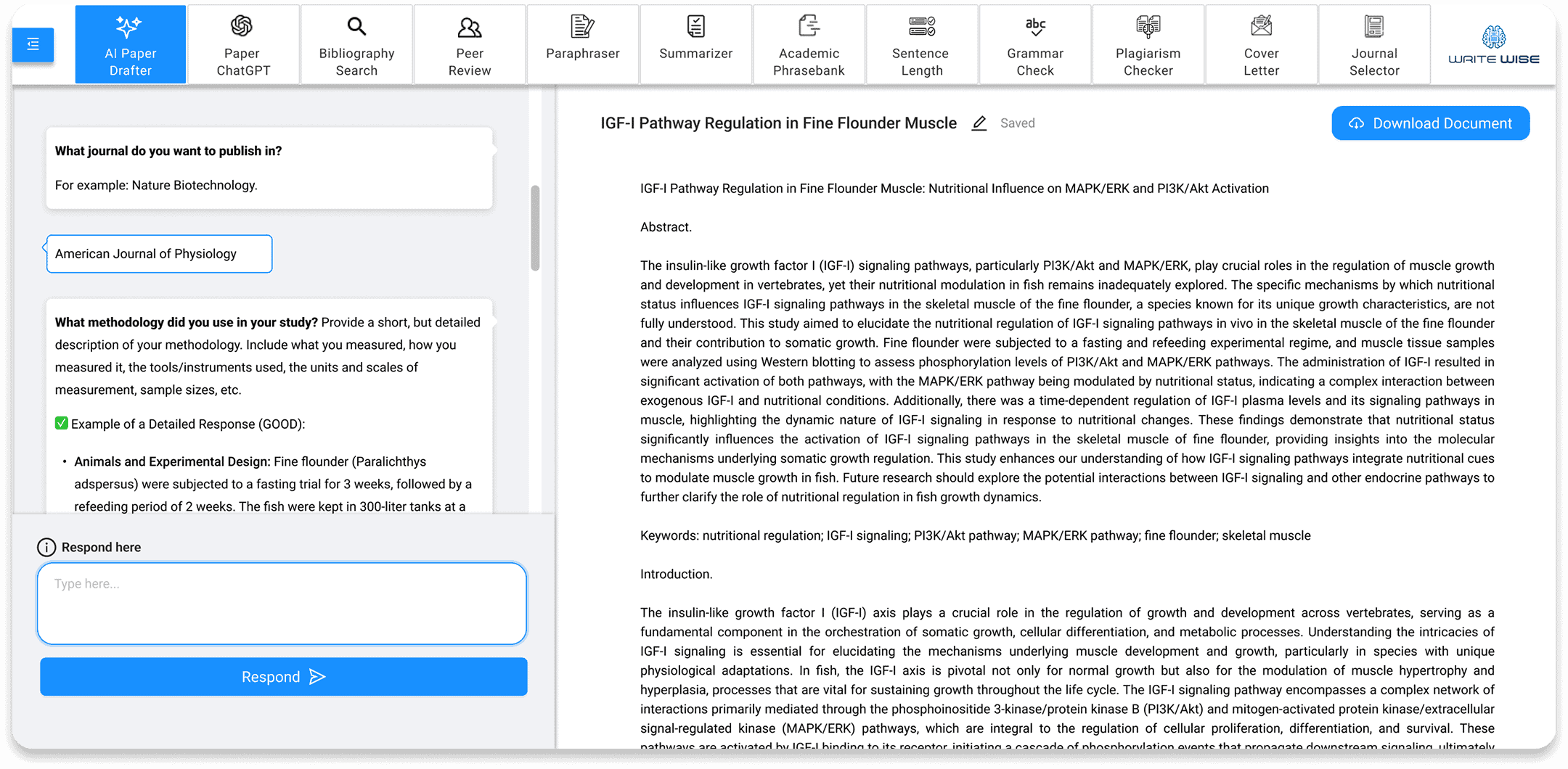
General AI assistants are useful for many writing tasks. AI Paper Drafter is oriented toward gathering the information that makes scientific writing specific and accountable.
You may need to develop the entire writing sequence and refine the prompt without built-in manuscript guidance.
Guided inputs orient the drafting process around the research itself, then give you a starting text to evaluate.
AI-generated text should be treated as material for critical review—not as independent scientific evidence.
Do not treat generated examples or unverified statements as study results.
Find and inspect the original scholarly sources before including citations in a manuscript.
Review authorship and disclosure requirements, and describe AI assistance accurately when required.
Academic authors describe the value of having help turning research ideas into a workable paper structure.
Before, I did not know how to start. My ideas were scattered.Claudia Álvarez · PhD student in Cellular & Molecular Biology, Universidad de Concepción. Excerpt from a researcher testimonial published on WriteWise.
Understand what this tool helps you do—and what still needs your own scientific judgment.
AI Paper Drafter is a WriteWise tool that helps researchers develop a structured academic first draft from guided inputs about their study. It is intended to support manuscript preparation and revision.
It can assist with producing an initial paper draft, but it does not conduct your research or replace your scholarly responsibility. You must review the text, supply accurate study details, check the sources, and revise the manuscript.
Useful starting material includes your research topic, question or objective, methodology, available results, and the main contribution you want to communicate. The more precise your information, the more grounded the draft can be.
Its purpose extends beyond creating an outline: it helps organize study information and form a starting academic draft. You can then develop and edit the resulting manuscript.
No generated draft should be assumed scientifically accurate without review. Check the study methods, results, factual statements, quotations, and every reference against the primary evidence.
The broader WriteWise platform includes tools for improving and reviewing existing text. If you already have a draft, you may find Paper Assistant, Language Check, or Peer Review particularly useful alongside drafting support.
No. Editorial decisions depend on research quality, journal suitability, peer review, and other factors outside any writing tool’s control.
Yes. WriteWise offers institutional options for universities and research teams, including licensing, onboarding, and training. Visit the university solutions page to explore these programs.
Bring your topic, methods, and findings into a structured first-draft process—then take the lead on improving, verifying, and submitting your work.
5-day trial · Payment method required · Cancel before the trial ends to avoid a charge